The street sweeper will clean the curb, green belts, and roadside gaps near the edge with close brushes, then use suction or specific water where the vehicle cannot safely reach. Four-wheel steering assists the driver in tracking a tight line; an arm mounted with a brush pulls litter from crevices while high-pressure water gets any remaining dirt chucked loose. In fact, the outcome is determined less by one badly wide pass than it is by having just chosen the correct tool to cover every few metres of road.
This shows why routes with many roadside edges are difficult to clean. Where parked vehicles rest, where drains soon clog with grit, where planting beds gather wrappers and traffic islands impede turning. Haide Sweeper has a solution for those transitions: the CHR6000SEV, on one electric platform. Haide Sweeper CHR6000SEV is powered by one electric platform for those transitions.
Why Edge Cleaning Takes More Control
Open pavement provides the operator a free line of travel and an expansive view in regard to debris. Concrete footpath changes geometry: dirt pushed against vertical face, buried in gutter or tucked up beneath a ledge. The brush must agitate that material but not hit the curb nor kick it back outside of the pickup zone.
Integrating a green belt acts as an additional edge for businesses. In a thin strip, hard pavement meets soil, mulch, tree guards, and substantial water. This is done with the intent of sweeping up litter at the fringe without driving brush into vegetation and/or discharging wash water in non-permitted areas. The objective is to gather the litter at the fringe without embedding that brush in vegetation or directing wash water into an area where it ought not go.
Curbs Turn Loose Debris into Dense Lines
Traffic and wind blow light material downstream while rain brings grit to gutters and drains. Afterwards, leaves catch against the curb face and retain smaller particles. A city street sweeper requires sufficient range to upend that line and enough finesse not to spread it all around, but more importantly, pull it inside.
The CHR6000SEV offers a front-brush cleaning width of 3,500 mm and standard sweeping up to 2,600mm. The wider coverage allows for a brush to hit the offset edge in open pavement. The standard envelope is easier to put where the lane narrows, and roadside furniture offers little margin. The regular envelope makes it less difficult to put back in directions of the narrower series or roadside fixtures that have little room.
Gaps Interrupt an Otherwise Clean Pass
A slight example of litter behind a post, next to a manhole cover, or in the notch between pavement and planting bed. One driver can’t shove the chassis into every crevice, while another run may not be beneficial. When those pockets are left unattended, they become the residue humans always see despite a clean main lane.
Often the faster answer is a planned stop with a hose or water jet. The machine stays put out of harm’s way, the crew clears the isolated area, and then it’s back on with your route. This makes auxiliary tools a part of the workflow instead of end-of-the-line fixes. This defines the auxiliary tools as part of standard operating procedure, not a retrofitting.
How a Street Sweeper Follows a Curb
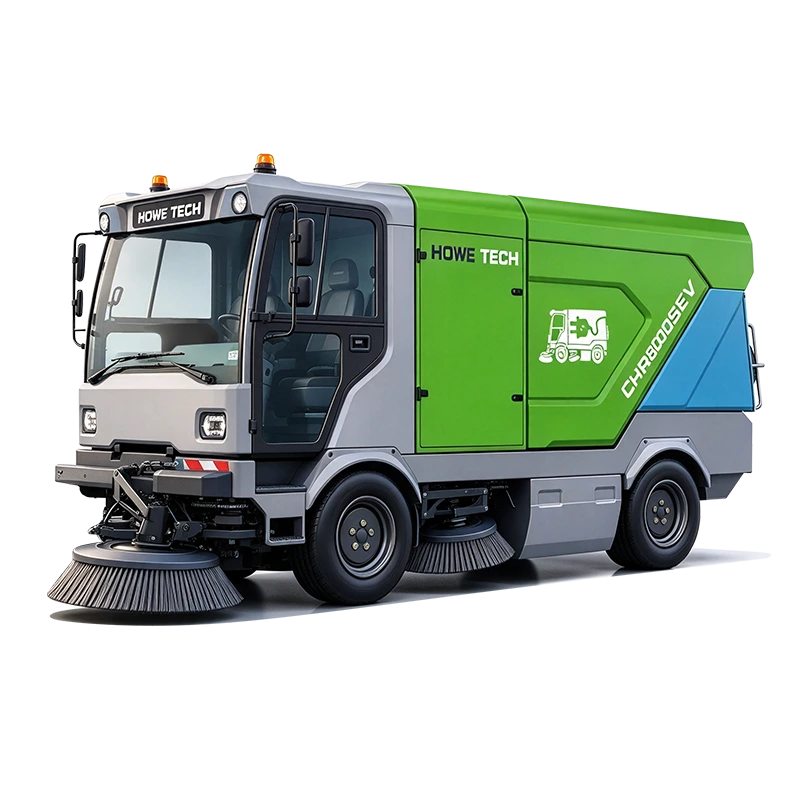
Brush reach only works if the vehicle can hold that distance from the edge. Even its 4×2 front-wheel drive and four-wheel steering work to your advantage in tight bends, offset approaches, and quick changes of direction. But fewer corrective movements mean it can hold the active brush over where debris actually is.
Speed must obey that condition of the curb. While the machine is capable of functioning at speeds up to 20 km/h, leaf-filled gutters, cracked pavement, and cars moving in tight quarters or limited visibility could mean a slower pass. It draws a cleaner edge than just maintaining the same speed consistently across the course.
Tools for Green Belts, Manholes, and Narrow Gaps
The CHR6000SEV Mechanical-Transmission Combined Sweeper is equipped with a 5 m x Φ125 mm rear handheld suction hose. That distance comes in handy at the edges of green-belt sections, around manhole covers, corners, and other outlying areas beyond most brushes. Removal of a small area of dry litter will not push the whole vehicle into an unfavorable approach.
When it comes to adhering dirt, the response will be varied. The system can even provide 10 MPa via a conventional (or non-pressurised)100 mm high-pressure line from the unit to your operator — allowing them space for their focus area. The trigger is supposed to be considered after noting things like runoff, apparent surface damage from past pedestrians or traffic, and if anything is growing nearby. Before the trigger is changed, runoff and surface damage (e.g., pedestrians) must be considered; planting in the neighborhood.
Suction is used to pick up any loose material; water liberates or washes off deposits that are still stuck. It’s important not to waste water — you can use a specific tool that’s appropriate for the condition; otherwise, you’ll have a pretty curb that wirestripes into an unplanned catch basin downstream. Rather, matching the tool to the condition keeps water out of a neat-looking curb that otherwise would just be creating yet another dirty drain underfoot farther down the road.
Moving Between Open Roads and Restricted Areas
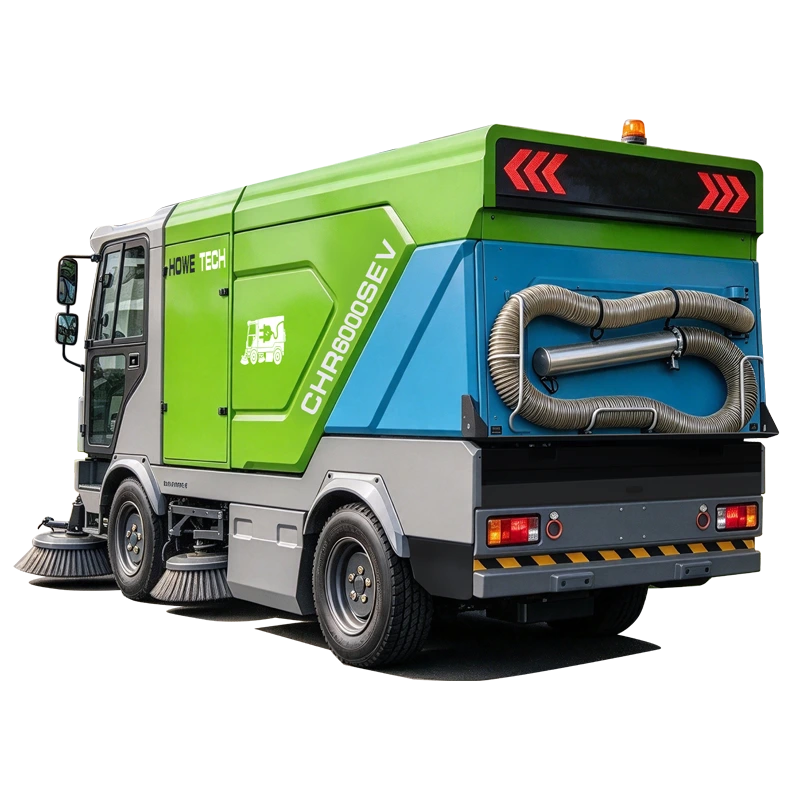
A typical city circuit with a wide road, traffic island, and service lane some distance away from the entrance to buildings. The sweeper makes those transitions thanks to four-wheel steering, and a standard cleaning width of 2,600 mm gives the driver a bounded working envelope. The wider cleaning path provides greater clearance.
Moving among dispersed work areas has an impact on the day, as well. The CHR6000SEV has a top speed in the conventional version that can be nominally limited to speeds of up to 40 km/h, while this option will go as high as or over 80 km/h. The value of that option depends mainly on road rules, operator procedures and spacing between routes as well as how the vehicle will be transported or driven from site to site.
Controlling Dust Near Sensitive Edges
Their placement often goes alongside parked cars, entrances and exit points provocatively close to pedestrian pathways or ventilation systems. An otherwise neat pass can therefore be undone by a dusty wake. That massive, 1,150 L water tank is responsible for surface moisture and washing – It helps remove debris from the roadside area around planting beds. The water tank helps with surface moisture and washing at 1,150 L capacity, while 22 m² of dry filtration area separates particles as they travel through the collection stream.
Not some fixed setting; the operator needs to assess by observing behind the plow after the cleaned strip. That means dry fines must be suppressed carefully, while moist leaves may require the brush to be held in stronger positions and water shall lose control over it. If a thin line of residue remains, using the handheld hose or varying speed may prove more productive than running over it again.
Handling Material Collected from the Edge
You can expect that curb pockets create an unexpectedly high load even if the middles of roads are clean. With that, the already-mentioned CHR6000SEV stores in a 6 m³ bin built of 304 stainless steel. The ability to have multiple edge stop doses means that these frequent stops at the edges do not become constant dumping here, and also the way bins are built lends well toward meat-suitable facilities where moisture is present.
At the point of discharge, the height range is adjustable to between 1,150 and 2,200 mm. This concept allows for better alignment of the sweeper with various receiving configurations. Like the previous approach, it requires level ground, ample overhead space, and a properly seated container, along with an unobstructed area around the vehicle. That was the final approach, and it still required level ground, sufficient overhead room, a properly positioned container, and an open area around the plant.
Selecting a Street Sweeper for Edge-Dense Routes
Before comparing, walk or map the route. Note narrow gates, curb length constraints, tight turns, and planted areas, but you also need to balance that against brush width, steering radius, appropriate hose reach, filtration water capacity, bin size, and soil compaction discharge height. The array of road-sweeping equipment offered by Haide Sweeper is more easily compared to that route profile than to motor vehicle size alone.
The CHR6000SEV is powered by a 186 kWh lithium iron phosphate battery, and features a 75kW travel system as well as an operating system rated at just 30 kilowatts. While it emits zero exhaust emissions during operation, charging access and shift planning are still part of the decision-making process. This is particularly relevant when long transfer sections and frequent hose or water use occur on the same day.
Conclusion
When the route takes a holistic approach to brush work, steering, suctioning dust and debris from surfaces using water with low-pressure spray components followed by unloading swept materials into an applicable location — there is no better machine than a street sweeper. With the CHR6000SEV chip, Haide Sweeper has a viable alternative for roads that constantly shift between open pavement and curbs, green belts, manhole covers, and roadside voids. Similar to cleaning width, having accurate access is what matters in these areas.
Explore service support for a more consistent street-cleaning routine.
FAQ
Q: How close can a street sweeper clean to a curb?
A: Using four-wheel steering to assist the operator in maintaining a proper line, sweeping width at front brush of 3,500 mm on CHR6000SEV. The handheld suction hose is also needed for deep recesses or interrupted curb sections.
Q: Can a street sweeper work beside green belts safely?
A: Yes, this is when an operator controls brush contact speed and the direction of water. Brushes need to stay on the hard surfaces rather than getting into vegetation, and water runoff should carry no dirt onto planting soil. For not very neat litter around tree guards or along irregular edges, the handheld suction hose is usually just a more precise solution.
Q: What should clean around a manhole cover?
A: The Rear Handheld Suction Hose can be used to pick up loose debris that the main brush cannot get at adequately. Stubborn deposits may require regulated high-pressure water. Regardless of the method, cover inspection should proceed prior to any type of opening in order to avoid an unsafe entry on a platform as well as prepare for runoff, while maintaining clear traffic areas and stabilizing composure.
Q: Is four-wheel steering useful beyond narrow streets?
A: Yes. Also covers traffic islands, loading areas, depot entrances, offset curb approaches, and paths with frequent changes of direction. The advantage is that the cleaning system is placed accurately and needs less repeated repositioning. The operator is still responsible for suitable clearance, local traffic conditions, and a proper working speed.