For a round that empties dozens of household bins, a garbage compactor truck usually makes sense. It takes repeated small loads into one body and packs them during the route. A hook lift truck does something else: it picks up a full detachable container and leaves an empty one behind. That distinction sounds obvious until a tender specifies only “garbage truck” and a body capacity. The daily pattern of collection, not the headline capacity, should decide which vehicle goes on the shortlist.
Start With the Collection Pattern
Picture two jobs. On the first, a crew works its way along residential streets, stopping at each group of bins. On the second, a market stores its waste in a large container and calls for an exchange when that container is full. Both move refuse to a disposal site, but they put the truck to work in very different ways. The residential truck spends much of its shift loading. The market truck spends more of its time traveling with a container.
A route record is more useful than a generic vehicle comparison. Note each stop, the bin or container type, the heaviest likely load, and the distance to the transfer station. Add the awkward details: a gate that narrows the approach, a slope where a container must be set down, or a disposal bay with limited height. If the crew has to reverse repeatedly, record that too. These are the places where an apparently suitable truck can lose time or become unsuitable.
Record the waste type too. Wet refuse, recyclables, and bulky material may require different loading or containment; nominal body volume will not settle that choice.
When a Garbage Compactor Truck Makes Sense
A compactor truck is designed for the stop-and-load rhythm. Waste enters a hopper, and the packing mechanism moves it into the fixed body. On a route with many small bins, that arrangement lets the crew keep collecting before the truck makes a disposal trip. The practical questions are whether the lifter matches the local bins, how the crew approaches the hopper, and how long a full loading cycle takes. Those answers matter more than a catalogue photograph.
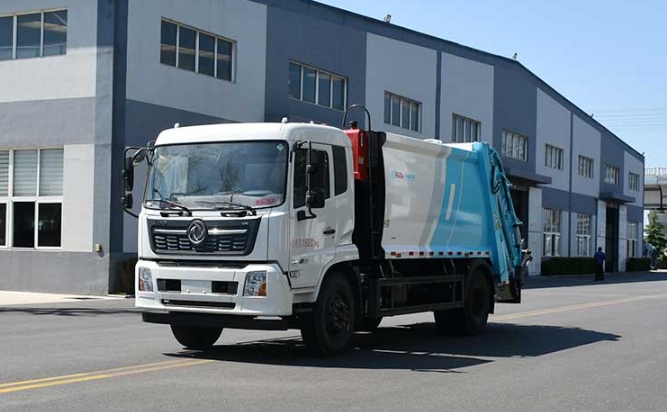
Haide describes its CHD5186ZYSDFE6E garbage compactor truck as a vehicle for collecting, compressing, transporting, and discharging municipal solid waste. It is a relevant reference model for a residential or similar route. The quoted unit still needs to be checked against the buyer’s bins, waste density, payload rules, and unloading site. Even a good compactor body cannot make a mismatched bin lifter work efficiently.
Rubble and large rigid objects may damage a hopper intended for ordinary refuse. Separated recyclables may also need a different handling method. Check the collection contract before specifying what enters the body.
When a Hook Lift Truck Makes Sense
A hook lift truck earns its place where containers stay on site between collections. The arm pulls a full container onto the chassis, and the operator can set an empty container down for the next cycle. This is useful at a transfer point, market, industrial site, or other location with room for the exchange. It is less persuasive on a street where a crew must empty many small bins one after another.
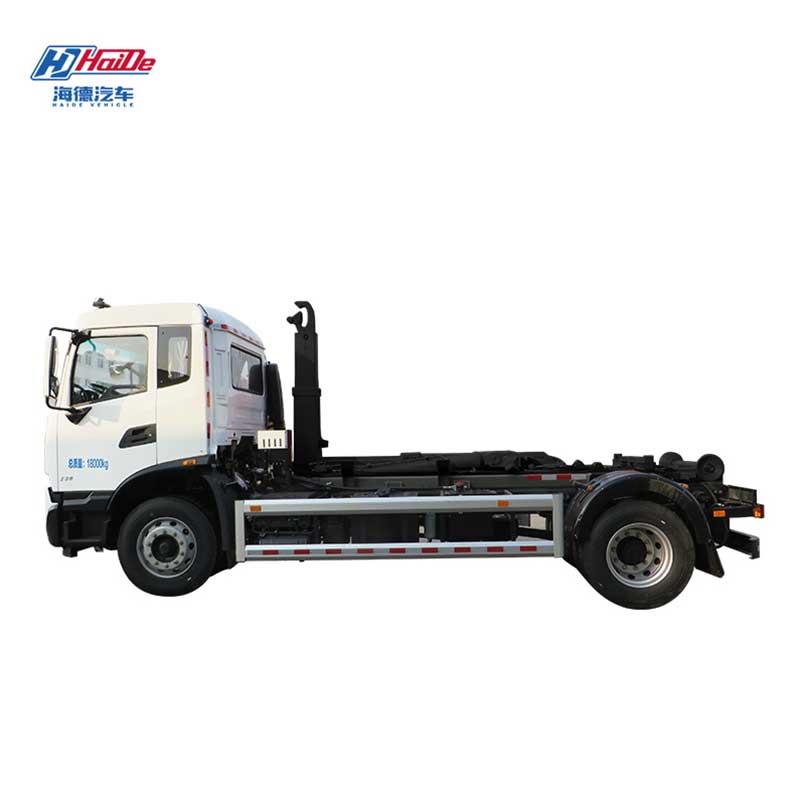
Haide’s CHD5180ZXXDFE6 hook lift garbage truck has a hydraulic arm, a locking arrangement, and rear support for loading and unloading. Those features address parts of the handling task, but they do not establish compatibility with an existing container fleet. Send the actual container drawing. Hook height, rail spacing, length, loaded mass, and the position of the locking points all need to match the proposed system.
The ground matters as much as the container. A site may have room to park a truck but too little clear space to roll a container off safely. A soft or uneven set-down area changes the loading problem again. Wet refuse introduces another question: is the specified container sealed well enough for transport? An open bin that is acceptable for dry bulky material should not be assumed suitable for a leachate-producing load.
Compare the Costs That the Route Actually Creates
There is no useful universal answer to “which truck is cheaper?” A compactor may need fewer disposal trips on a dense bin route, yet it carries a packing mechanism that requires maintenance and consumables. A hook lift may let one chassis serve several fixed sites, but the operation also needs enough containers to keep those sites running while full ones are away. Count the containers as part of the system, not as an afterthought.
Build the estimate from a normal week: crew hours, loading time, disposal trips, fuel or electricity, parts, and service. Test a busy week as well. A truck that just fits the average load may need an extra trip at peak volume. Allow for realistic repair time if missed collections carry a penalty.
For overseas buyers, service terms deserve a line in the comparison. Haide publishes remote technical support, training, parts arrangements, and possible on-site help. The public description does not tell a buyer which parts are stocked in their country or which response time applies to their contract. Put those points into the quotation request. A low purchase price is little comfort when a commonly worn part has to travel across borders.
A Procurement Checklist for Either Vehicle
Give suppliers a route pack rather than a request for a “10 cubic metre garbage truck.” Include bin drawings, daily mass, road and gate limits, loading-surface conditions, disposal-site access, and local vehicle rules. A bidder can then identify the standard model, required options, and any remaining site checks.
Haide offers both fixed-body collection and container transport, and its ODM and KD program describes custom development and local assembly cooperation. That breadth is useful when a city or distributor runs several kinds of route. It does not remove the need for a written configuration. Before signing, compare the proposed truck, container or bins, documentation, operator training, and service obligations as one package.
Conclusion
A garbage compactor truck fits repeated pickup from small bins; a hook lift truck fits the exchange of larger detachable containers. A mixed fleet may be the sensible answer when both jobs exist. Haide has models in each category and can discuss adaptation to local requirements. The buyer’s strongest starting point is a route pack with real container dimensions and a representative waste load, followed by a demonstration against that pack.
FAQ
Q: Can one hook lift truck replace a residential compactor route?
A: Usually not without changing the collection system. A hook lift moves a whole detachable container, while a compactor accepts many small loads during a round. If households still use individual bins, someone must first consolidate their waste into a suitable container. Compare the entire workflow, including labor and container locations, before removing the compactor from the fleet plan.
Q: Is a hook lift suitable for wet municipal waste?
A: It can be, provided the selected container is designed and sealed for that waste stream and the local rules allow its use. The hook mechanism alone does not prevent leakage. Ask to inspect the container, locking arrangement, and unloading procedure with representative wet material. An open container for dry bulky waste is a different specification.
Q: What should be measured before ordering a hook lift truck?
A: Measure the existing containers and the exchange site. The drawing should show hook height, rail spacing, container length, locking points, and maximum loaded mass. Record the clear space behind the truck, surface condition, slopes, and route weight limits. Haide should then confirm arm, chassis, and container compatibility for the exact quoted configuration.
Q: How should operating costs be compared fairly?
A: Use the same collection volume and period for both options. Include labor, loading and exchange time, disposal trips, fuel or power, maintenance, parts, containers, and downtime cover. Run the calculation for an ordinary week and a peak week. Comparing purchase prices alone leaves out the costs created by the route itself.
Q: Can Haide build around local bins or containers?
A: Haide describes customized product development through ODM and local assembly cooperation through KD. Whether a particular bin, container, chassis, or regulatory requirement can be accommodated needs a technical review. Provide drawings and operating conditions, then ask for a written specification, acceptance test, and service agreement. A general customization offer is not approval of every proposed configuration.