The right garbage bin cleaning equipment depends on how bins are distributed, where wastewater can be handled, and whether the cleaning team works at one site or along a route. Mobile units suit dispersed locations, fixed stations support concentrated workloads, and truck-mounted systems combine transport, washing, and wastewater storage. A useful comparison therefore starts with workflow and site access before it turns to individual machine features.
What Garbage Bin Cleaning Equipment Must Accomplish
A complete cleaning process must reach the inner walls, base, rim, lid, wheels, and exterior surfaces of a waste bin. High-pressure rotating nozzles address internal residue, while surrounding spray bars or handheld guns remove material from exterior crevices and areas beyond the fixed spray pattern.
Containment is equally important. An enclosed chamber limits splash, and separate clean-water and wastewater paths prevent dirty liquid from returning directly to the work area. Where discharge infrastructure is limited, filtration and reuse can extend operating time and reduce the volume of fresh water required.
How High-Pressure Bin Cleaning Works
Internal and External Coverage
The cleaning chamber determines whether a machine can treat more than the easiest visible surfaces. Haide Sweeper systems use configurations such as 360-degree rotating nozzles, vertically moving internal jets, perimeter spray bars, or a rotating washing compartment to clean the inside and outside of compatible bins.
A handheld spray gun adds control when grease, compacted residue, wheel assemblies, or nearby hard surfaces need extra attention. This auxiliary tool should complement the enclosed cycle rather than replace it, because manual spraying alone provides less consistent containment and coverage.
Wastewater Collection and Reuse
The best wastewater arrangement depends on the site. A fixed facility may connect to an established drainage and treatment process, while a mobile bin washer must collect liquid during relocation and discharge it at an approved location. Some configurations filter and recirculate wastewater, reducing dependence on repeated refilling during extended outdoor work.
Recycling does not remove the need for maintenance. Filters, settling stages, pumps, and storage tanks must remain accessible for inspection and cleaning, and operators still need a clear plan for handling concentrated residue and final wastewater discharge.
Main Types of Garbage Bin Cleaning Equipment
Mobile Bin Washing Machines
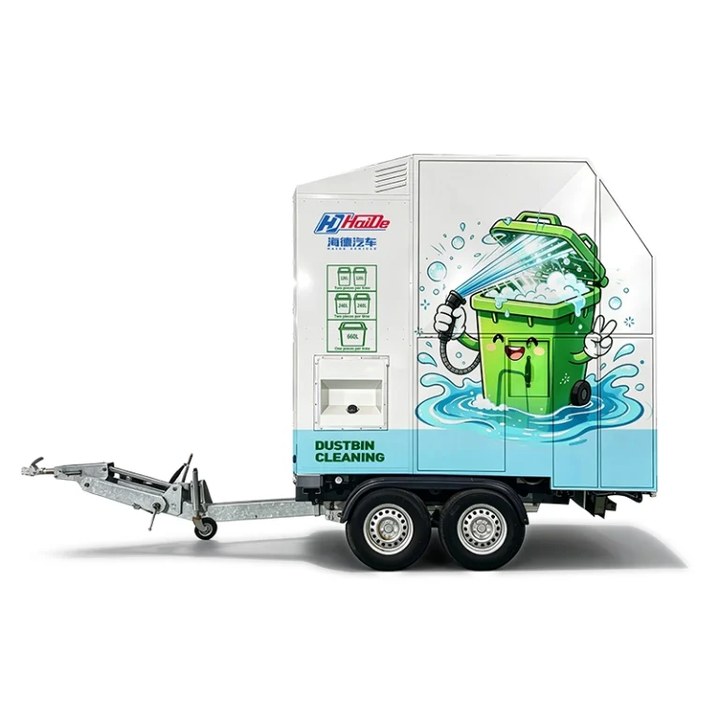
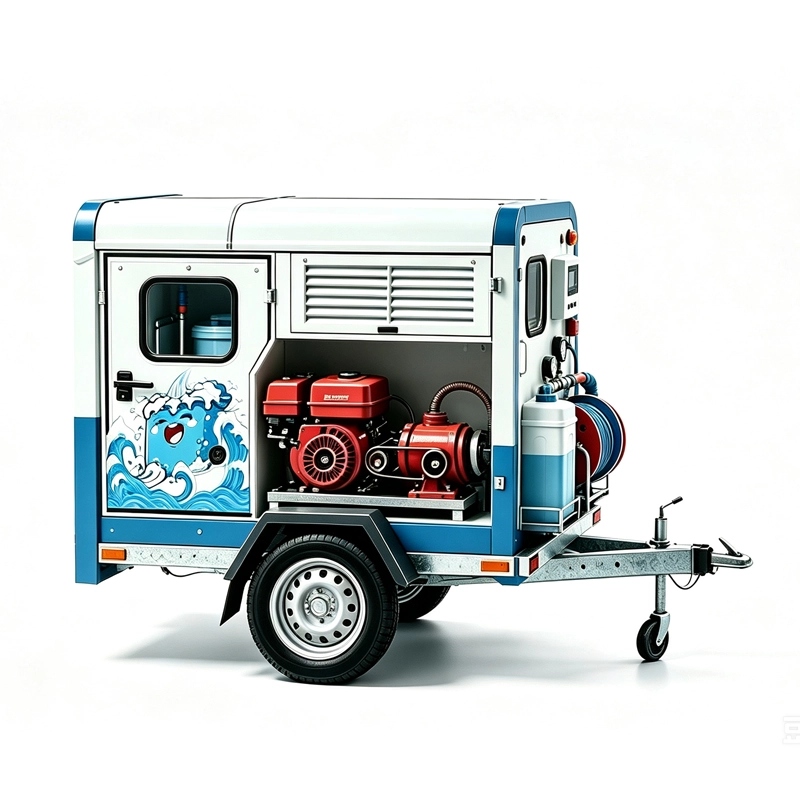
Mobile equipment is appropriate when bins are spread across residential communities, roadside collection points, campuses, or multiple service areas. The CHD100TQX can switch between a single-axle trailer arrangement and pickup-bed installation, while its independent gasoline-powered high-pressure system supports work without an external electrical connection. It handles standard 120 L and 240 L plastic bins individually and offers an optional multi-stage wastewater purification system.
For larger mobile workloads, towed bin washing equipment adds automatic lifting and clamping, enclosed internal and external washing, and compatibility with standard 120 L, 240 L, and 660 L bins. The CHD103TQX uses a diesel power system, two internal rotating nozzles, surrounding spray bars, a 500 L clean-water tank, and heated water with a stated outlet range of 60-80 degrees Celsius.
Fixed Bin Cleaning Stations
A fixed station is better suited to depots, transfer areas, or centralized sanitation sites where bins return to one cleaning point. The CHD0101QXZ uses a fully enclosed system and can wash two 120 L or 240 L bins in one session, or one 660 L bin. Its selectable light, medium, and heavy modes allow the cycle to reflect the condition of the incoming bins.
The fixed bin cleaning station uses a high-pressure plunger pump rated at 14 MPa and 66 L/min, a 30 kW motor, and a 380 V AC supply. Two rotating nozzles clean the interior, while reciprocating spray assemblies address the front, lid, sides, and back; a handheld gun extends auxiliary cleaning within a five-meter radius.
Truck-Mounted Cleaning Systems
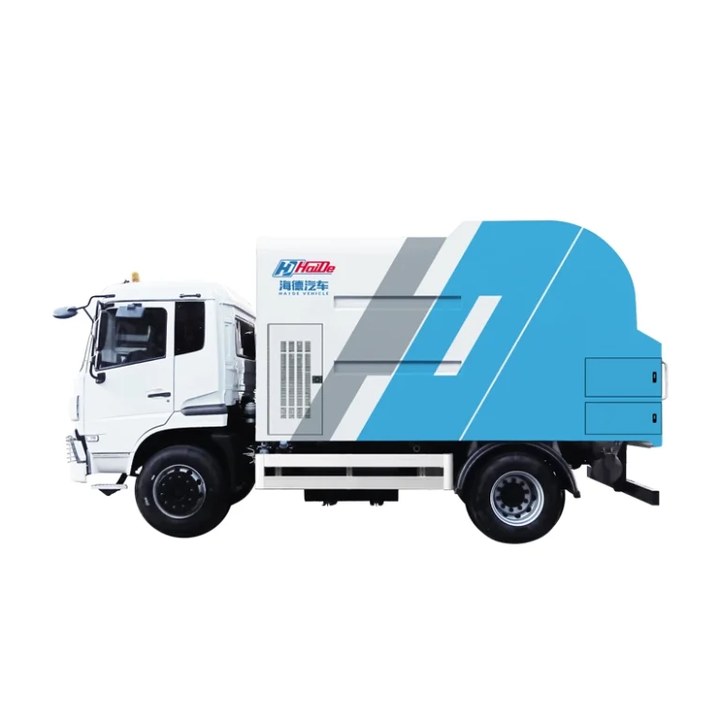
A dustbin cleaning truck is designed for route-based work where transport and washing need to remain on the same vehicle. The CHD5120TQXDFE6 combines a rear-mounted enclosed compartment with clean-water and wastewater tanks, high-pressure water, pneumatic controls, hydraulics, disinfectant spraying, and a winter pipeline drainage function.
Its cleaning chamber uses a 360-degree rotating nozzle for the bin interior and perimeter jets for the exterior. The truck accepts standard 120 L, 240 L, 660 L, and 1100 L bins, while its high-pressure pump is rated at 16 MPa and 130 L/min. This format is relevant when a service route covers many collection points and returning every bin to a central station would interrupt the workflow.
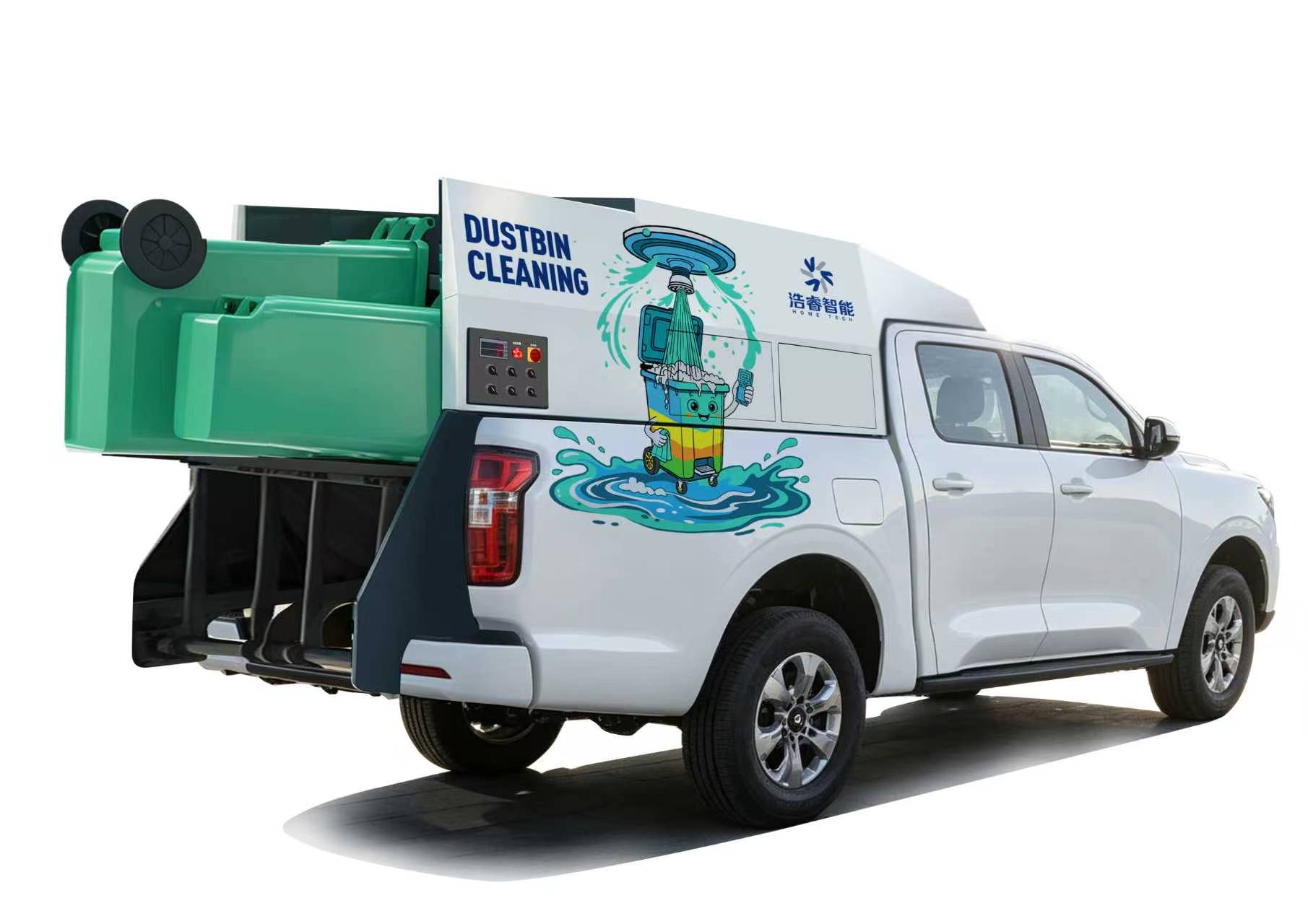
For routes dominated by standard 120 L and 240 L bins, the CHD1035TQX provides a more compact truck-mounted alternative. Built around a pickup-style cargo truck chassis, it combines automatic bin tilting and positioning with high-temperature steam cleaning and a handheld spray gun. The vehicle is designed to bring cleaning and disinfection directly to collection points while maintaining greater maneuverability than a larger dedicated cleaning truck. This configuration is particularly suitable for communities, hospitals, clinics, sanitation service routes, and other locations where standard-size bins need frequent on-site cleaning. With separate 500 L clean-water and 500 L sewage tanks, the CHD1035TQX can support mobile cleaning work without relying on a fixed washing station at every service point.
How to Choose the Right Bin Cleaning System
Match the Equipment to Bin Distribution
Start by mapping where bins are stored, how often they are cleaned, and how far the equipment must travel between groups. Residential communities, narrow lanes, parks, and scattered collection points generally benefit from mobile bin washing machines. Where routes mainly use standard 120 L and 240 L bins but require vehicle-based operation, a compact pickup-mounted model such as the CHD1035TQX can provide a practical balance between mobility and onboard cleaning capability. Transfer areas and sanitation depots with concentrated bin returns are stronger candidates for fixed stations, while routes involving 660 L or 1100 L containers may require a larger dedicated dustbin cleaning truck
Check Utilities, Drainage, and Site Access
A fixed station requires suitable floor space, a 380 V supply for the specified configuration, water access, and a controlled wastewater pathway. Mobile systems require an appropriate towing or carrying vehicle, safe operating space, and a planned discharge point. Vehicle payload, towing rules, and local road requirements should be checked separately because site and jurisdictional conditions are not universal.
Compare Automation with Maintenance Access
Automatic lifting, turnover, clamping, adjustable cycles, and operating-status displays can improve repeatability for frequent cleaning. Simpler manual-loading equipment may be easier to deploy for lower-volume work. Haide Sweeper selection should therefore balance labor demands with access to nozzles, pumps, filters, tanks, and other components that require routine attention.
Where Each System Fits
Residential communities, narrow lanes, parks, and scattered collection points generally benefit from mobile bin washing machines. Transfer areas, sanitation depots, and facilities with concentrated bin returns are stronger candidates for fixed stations. Urban and rural routes with numerous stops can justify a dedicated dustbin cleaning truck when onboard water, wastewater separation, and automated handling support the planned daily sequence.
The equipment should also match the actual bin mix. Selecting a dustbin cleaning system around the largest bin alone may create unnecessary complexity, while ignoring occasional larger containers can leave a service gap. Confirm compatible capacities, batch quantity, loading method, available cleaning modes, and the complete water-handling process before finalizing the configuration.
Conclusion
Garbage bin cleaning equipment creates the most value when its cleaning chamber, mobility, water management, and operating method support the real service pattern. Mobile machines bring cleaning to distributed bins, fixed stations organize centralized work, and truck-mounted systems keep route operations together. Haide Sweeper provides options across these formats, allowing sanitation teams to choose a system around access, workload, containment, and maintainability rather than a single headline specification.
Explore Haide Sweeper garbage bin cleaning equipment for a solution aligned with your operating environment.
FAQ
Q: What types of garbage bin cleaning equipment are available?
A: The main formats are compact mobile washers, dedicated trailer-mounted machines, fixed cleaning stations, and truck-mounted systems. Mobile equipment serves dispersed bins, fixed stations suit centralized return points, and cleaning trucks support continuous routes. The right format depends on access, bin sizes, utilities, wastewater handling, and the level of automated loading required.
Q: When is a mobile bin washer preferable to a fixed station?
A: A mobile bin washer is preferable when bins remain at multiple communities, collection points, parks, or roadside locations. It reduces the need to transport every bin to a depot. The operating plan must still account for towing or vehicle payload, fresh-water replenishment, wastewater storage, safe setup space, and compliant discharge after the cleaning route.
Q: How does enclosed high-pressure cleaning improve the process?
A: An enclosed chamber directs rotating nozzles and surrounding spray jets toward the inner and outer surfaces while limiting splash. This improves coverage around rims, walls, lids, and crevices and helps keep wastewater within the machine. Handheld spray guns remain useful for stubborn deposits, wheels, and nearby surfaces that need additional targeted cleaning.
Q: What should be checked before selecting a wastewater recycling system?
A: Check how the system separates solids, filters water, controls odors, and allows access to pumps and filter elements. Confirm where concentrated residue and final wastewater will be discharged. Recycling can reduce fresh-water demand and extend field operation, but it still requires scheduled inspection, cleaning, consumable replacement, and a site-specific wastewater management plan.