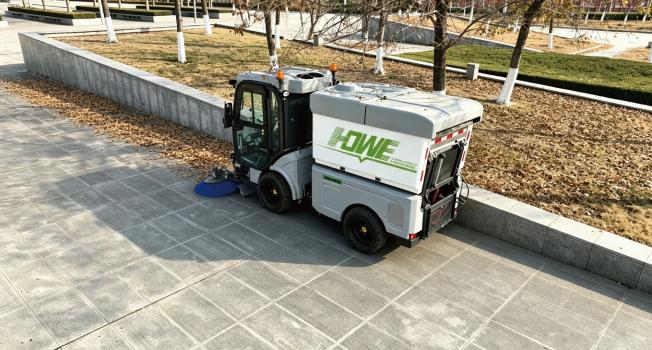
An electric compact street sweeper is best suited to narrow urban spaces when its body width, steering geometry, sweeping path, battery endurance, dust-control system, and unloading arrangement match the route. Selection should begin with the actual site. Parks, stations, residential areas, ports, docks, sidewalks, and service roads place different demands on maneuverability, debris capacity, water use, charging time, operator visibility, and seasonal functions.
Why an Electric Compact Street Sweeper Fits Modern Urban Cleaning
Access Without Sacrificing Working Capacity
Full-size road sweeper trucks can cover broad roads efficiently, but their dimensions may limit access near curbs, landscaped paths, station forecourts, and internal service lanes. A compact platform reduces the space required for travel and positioning while retaining a useful cleaning path.
The Haide Sweeper compact street sweeper range includes dedicated-chassis machines designed for locations where access, maneuverability, and multi-purpose use matter. For the CHR52MHEV, the combination of articulation and modular front or rear attachments extends the machine beyond routine sweeping.
Electric Operation in Sensitive Locations
Pure-electric operation removes tailpipe exhaust at the point of use and supports work in residential areas, parks, stations, and other environments where local emissions and operating disturbance deserve close attention. Effective cleaning still depends on the complete system, including brush contact, suction airflow, circulating-water dust control, and route planning.
Compact Street Sweeper Dust Control, Suction, and Waste Handling
Circulating Water and Brush Spray
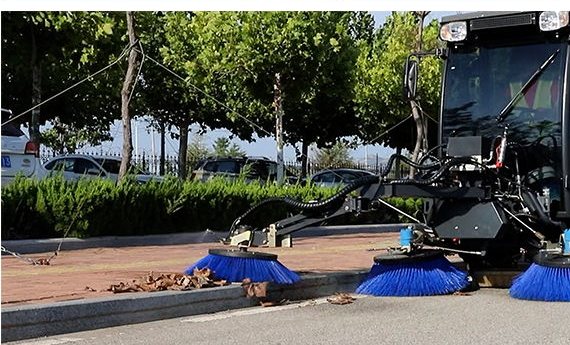
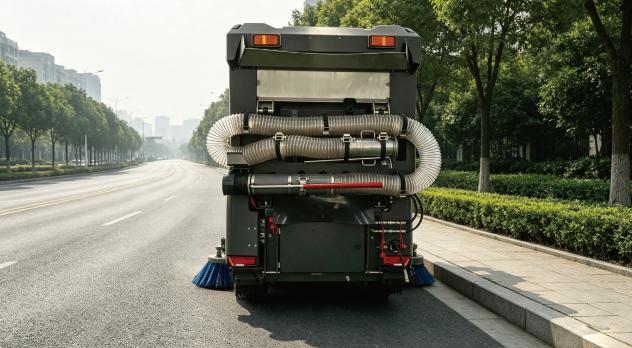
The CHR52MHEV combines a 270 L clean-water tank with a large-flow circulating-water dust-control system. Water flows toward the suction inlet, mixes with dust in the suction pipe, passes through a dedicated filter, and returns for reuse. Four suppression nozzles above the brushes and a high-flow spray at the suction inlet provide secondary dust control.
The suction system uses a centrifugal fan and a 180 mm suction pipe. This layout is relevant for fine dust, leaves, litter, and mixed road debris, but the most suitable operating speed and water use should be adjusted to the surface and contamination level.
High-Level Dumping and Auxiliary Cleaning
A 2 m³ stainless-steel waste container provides greater debris capacity than smaller compact platforms. The high-dump system raises the container to a discharge height of 1,460 mm, allowing waste to be transferred directly into a receiving container while reducing manual handling.
Auxiliary cleaning equipment further improves operational flexibility. A 120 mm retractable hand-held suction hose collects debris from green belts and other hard-to-reach areas, while an emergency hand pump allows the container to be raised for troubleshooting if the hydraulic system fails. A high-pressure washing system with a 10 m hose can clean the brushes, suction inlets, vehicle body, and residual dirt on the working surface.
Multi–functional Road Sweeper for Year-Round Tasks
Tool-Free Function Changes
The dedicated chassis is designed as a vehicle platform with modular functional accessories. By changing front attachments or connecting rear accessories, the CHR52MHEV can support sweeping, floor washing, third-brush work, snow pushing, snow sweeping, snow lifting, and spreading.
This approach can improve utilization across seasons, but every attachment changes the machine’s working envelope, energy demand, surface interaction, and operator procedure. Clearance and route suitability should be reassessed whenever the operating module changes.
Visibility, Control, and Collision Protection
The panoramic glass cab, hydraulic steering, cruise control, reverse imaging, and digital vehicle controls are intended to support precise operation. Available control features include a 360-degree surround-view system, stepless brush-speed adjustment, automatic lifting of the brush and suction equipment when reverse is selected, and multiple collision-avoidance structures around the brush system.
These systems can improve awareness and protect vulnerable working components, but they do not replace route training. Operators still need procedures for pedestrians, blind entrances, night work, wet surfaces, loose gravel, and crowded loading areas.
Matching an Urban Street Sweeper to the Cleaning Environment
Parks, Stations, and Residential Areas
In public or residential environments, prioritize access width, low-speed control, visibility, local operating disturbance, and safe separation from pedestrians. The 1,350 mm body width should be checked against gates, bollards, ramps, and the usable width left by parked vehicles.
Ports, Docks, and Facility Roads
Ports, docks, campuses, and industrial facilities may produce sand, packaging fragments, leaves, and tracked material. The 2 m³ container and 2,400 mm sweeping path can support larger routes, while the 20 percent full-load gradient rating and selectable drive functions should be considered where slopes or low-traction surfaces are present.
Surface Types and Seasonal Conditions
The sweeper can work on brick, cement, asphalt, rubble, gravel, and rough concrete pavements. Site teams should still inspect joint depth, loose aggregate, drainage, curb height, and surface damage before setting brush pressure, speed, and water use.
Evaluating an Electric Road Sweeper Before Deployment
A useful trial should reproduce the hardest section of the route: the tightest turn, steepest grade, heaviest debris, most uneven pavement, and actual unloading point. It should also test the distance to charging and water facilities instead of evaluating cleaning performance in isolation.
Haide Sweeper is a relevant option when a route needs pure-electric operation, high-capacity collection, modular functions, high-level dumping, and articulated maneuverability in one platform. The final configuration should follow measured site conditions, seasonal duties, and the infrastructure available during a complete operating shift.
Conclusion
The value of an electric compact street sweeper comes from balancing access with working capacity. The CHR52MHEV combines a 1,350 mm body width, 2,400 mm sweeping width, 93.38 kWh battery system, 2 m³ stainless-steel container, circulating-water dust control, and modular attachments in a dedicated electric chassis.
Those specifications become useful only when they match the route’s geometry, debris load, surface type, charging window, water access, and unloading arrangement. Careful site measurement remains the clearest path to dependable daily cleaning and better year-round equipment utilization.
Please contact us to explore Haide Sweeper solutions for demanding urban cleaning routes.
FAQ
Q: What makes the CHR52MHEV a compact electric road sweeper?
A: Its 1,350 mm body width, articulated chassis, controlled working speed, and front-mounted cleaning system support operation in parks, stations, residential areas, ports, docks, and facility roads. It also provides a 2,400 mm sweeping width and 2 m³ container, balancing access with useful route capacity.
Q: How long can the CHR52MHEV work between charges?
A: The CHR52MHEV has an operating period of 8-10 hours and a charging time of 2-3 hours. Actual runtime varies with gradients, travel distance, debris load, hydraulic demand, attachment use, temperature, and stop frequency, so shift planning should include charging, water filling, and unloading time.
Q: Which cleaning functions can the CHR52MHEV perform?
A: Its modular platform can support sweeping, floor washing, third-brush cleaning, snow pushing, snow sweeping, snow lifting, and spreading by changing front modules or connecting rear accessories. Each attachment changes the operating envelope and energy demand, so route clearance and procedures should be reviewed for every configuration.
Q: What surfaces can this electric compact street sweeper clean?
A: The sweeper can clean brick, cement, asphalt, rubble, gravel, and rough concrete pavements. Suitability still depends on surface damage, loose aggregate, joint depth, drainage, curb design, and debris type. Operators should adjust brush speed, vehicle speed, and water use after inspecting the actual working surface.